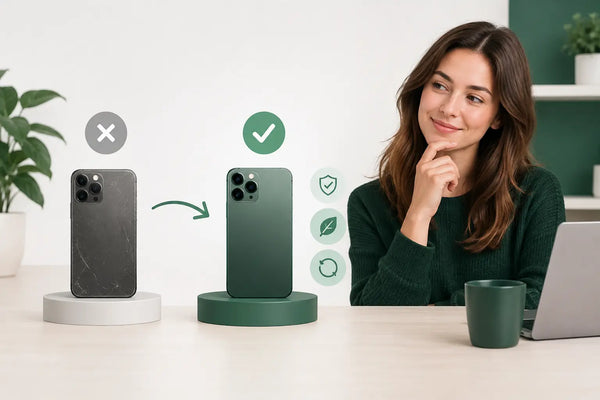
A refurbished iPhone can save you hundreds of euros, but only if you know what you are buying. The question how to avoid a bad buy when purchasing refurbished therefore does not just revolve around the lowest price. It is about the combination of device condition, battery, warranty, return options, and the party supplying the device.
With a private second-hand purchase, a low price is sometimes attractive, but you often do not know what a device has been through. With refurbished, you are buying for greater peace of mind: an iPhone that has been checked, technically tested, and clearly offered with agreements regarding warranty and returns. Still, providers and devices differ from one another. With these points of attention, you will make a better and more relaxed choice.
Look beyond just the price
A refurbished iPhone is more affordable than a new device, but prices can vary significantly between providers. There is usually a reason for that difference. Think of the cosmetic condition, battery status, storage capacity, accessories, or the length of the warranty.
Therefore, never just compare the amount under the product photo. Look at what you are actually getting for it. A device that is slightly more expensive, but has a 24-month warranty and a 30-day return policy, can be a wiser choice than a cheaper offer without clear terms and conditions.
Also pay attention to the storage space. Those who mainly make calls, use apps, and save photos occasionally often have enough with a lower storage capacity. If you make many videos, use many apps, or want to use the device for years to come, extra storage will prevent you from quickly running into a full iPhone. The cheapest version is not automatically the best buy for your usage.
Understand what condition really means
The condition of a refurbished iPhone usually refers to its appearance, not its technical functionality. A device with slight signs of use can therefore technically function just as well as an example that looks almost new.
Many providers work with conditions such as 'as good as new', 'lightly used', or 'visibly used'. Always read how that classification is explained. With a lighter condition, you can, for example, expect small scratches on the housing or the screen. That is not a problem if you use a case anyway and mainly want to save money. If you want an iPhone that you are giving as a gift or that needs to look as neat as possible, then a better cosmetic condition is probably worth the extra investment.
Also check whether the description makes it clear that the screen and housing have been assessed for signs of use. Vague terms like 'good condition' without further explanation provide less guidance. Transparency about what you can expect is actually a sign that a provider does not need to make things look better than they are.
Technically good and looking neat are two different things
This distinction prevents a lot of disappointment. A small scratch does not mean that the camera, speakers, or buttons work any less well. Conversely, a nice appearance in itself says nothing about the technical check. Therefore, look for information about the parts and functions that have been tested, such as the screen, cameras, microphone, speakers, buttons, connections, and charging.
Ask about the battery and read the terms
The battery is the most exciting part of a refurbished iPhone for many buyers. Understandably so, because the battery partly determines how long you can get through the day without charging. At the same time, there is no universal answer to the question of which battery is good enough for everyone. That depends on your usage, the chosen model, and how long you want to keep the iPhone.
Check in advance what the seller promises regarding battery capacity. Is a minimum battery condition stated, or is it explained when a battery is replaced? Then you know better where you stand. If that information is completely missing, it is wise to ask for clarity first.
Also consider your own patterns. Someone who navigates, watches videos, or works mobile all day has different requirements than someone who mainly sends messages and makes calls. A power bank might be fine for some users, but it is not a solution if you actually need a device that can handle a busy working day without worries.
Check warranty, return rights, and accessibility
You don't just buy a refurbished iPhone for today. You also want to know what happens if something turns out to be wrong upon receipt. Clear warranty terms are therefore not fine print, but an important part of your purchase.
Pay attention to the duration of the warranty and read what it applies to. At Refurbished.nu, you get a 2-year warranty and a 30-day return period. That gives you the space to use the device at home in peace, evaluate it, and check if it meets your expectations.
Also check whether you can easily reach customer service in Dutch. Especially if you need a replacement iPhone quickly, you don't want to wait days for a vague answer. Accessible customer service and clear information about repairs or returns make a big difference when you need help.
Also read what you should do immediately upon receipt
Carry out a few practical checks upon delivery. Check whether the condition matches the order, insert your SIM card or set up an eSIM, test calling and mobile internet, and open the cameras. Also try Face ID, speakers, microphone, charging port, and Wi-Fi. You don't have to be a technical expert: normal use often quickly shows whether everything works as expected.
Keep the packaging and documents for the first few weeks. Not because you should assume there will be problems, but because returning or submitting a question becomes easier if you have everything at hand.
Choose a model that fits your daily use
A bad buy sometimes does not arise from the condition of the device, but because the chosen model does not suit the user. A compact model can be nice in a pocket, but less suitable if you read a lot, work, or watch videos. A larger screen offers more space, but also makes the iPhone heavier and less handy.
Think about three things in advance: screen size, camera, and battery life. Do you mainly want a reliable phone for messaging, banking, and everyday photos? Then you don't necessarily have to choose the newest or largest model. If you are looking for better capabilities for photo and video, a lot of storage, or a spacious screen for work and entertainment, it pays to compare models side by side.
Also pay attention to future software support and your desired usage period. Anyone who only needs an iPhone for a year or two can easily consider an older model. If you want to use it for as long as possible, a newer model is often more logical. That sometimes costs more at the time of purchase, but can turn out to be more economical per year of use.
How to avoid a bad buy with refurbished providers?
You can recognize a reliable provider not by big promises, but by concrete information. You should be able to see without searching what the condition means, how the battery is assessed, how much warranty you get, and how returning works. It should also be clear exactly which iPhone you are ordering: model, color, storage capacity, and condition.
Be careful if product information is incomplete or terms are difficult to find. A sharp price only remains attractive if you know what happens in the event of a defect, a disappointing condition, or a battery that does not meet your expectations.
Finally, check whether the device is SIM-lock free and suitable for your provider. For most buyers, that goes without saying, but checking it beforehand prevents hassle as soon as you set up the iPhone. If you still have a physical SIM card, also check which type of SIM card your current subscription uses. With some models, you can also opt for an eSIM.
Take five minutes before you order
A good purchasing decision doesn't have to be complicated. Compare the offer with your own wishes and answer honestly: how much storage do I need, how many signs of use do I find acceptable, how important is battery life, and what certainty do I expect after purchase? Then compare the product information and conditions, not just the price.
Those who take those five minutes do not buy an iPhone based on a quick offer, but choose a device that really fits. That is ultimately the best way to save money with a refurbished iPhone without compromising on confidence.